What level of care do I need for addiction treatment?
Deciding to begin addiction treatment is a powerful and courageous choice. It takes honesty, reflection, and the willingness to ask for help. Once that decision is made, the next natural question is, “What levels of addiction do I need?” The answer matters because the right placement sets the foundation for lasting recovery.
What are levels of care?
One of the best ways to reduce the anxiety around entering a program is to learn about the different levels of addiction. Education not only helps you understand what treatment looks like but also gives you a sense of what might fit your needs. While a qualified treatment center will perform an evaluation and recommend a level for you, having your own knowledge can make the process less intimidating.
It may also help to know you are not alone. According to the 2024 National Survey on Drug Use and Health (NSDUH) from the Substance Abuse and Mental Health Services Administration (SAMHSA), more than 4.3 million people aged 12 or older received substance use treatment in 2023. Millions of individuals face the same questions about where to begin, and there are well-established answers to guide the way.
In general, treatment levels fall into three broad categories: medical detoxification, residential treatment, and outpatient treatment. Some facilities specialize in one type, while others provide the full continuum of care levels, offering multiple levels of addiction in the same location. This integration makes it easier to move between services without disrupting progress. Beyond these broad categories are more specific services—such as partial hospitalization and intensive outpatient programs—that fine-tune the level of medical oversight and structure. These sublevels are what clinicians refer to as the official ASAM levels of care, and they allow for highly individualized, evidence-based planning.
What are the ASAM criteria?
The American Society of Addiction Medicine (ASAM)—often called the society of addiction medicine—was founded in the 1950s to define addiction as a medical condition and to research effective approaches for treatment. Over the decades, ASAM has become the leading authority in addiction medicine, setting the standard for evidence-based care. Today, the ASAM Criteria are the most widely used clinical guidelines for determining the appropriate level of care. Many psychiatrists, physicians, and addiction specialists are trained within this framework, and ASAM itself offers certifications for providers who follow its model.
The ASAM Criteria provide a multidimensional framework to ensure care is safe, individualized, and responsive to each patient’s needs. By assessing medical, psychological, and social risks, clinicians can place patients in the least restrictive level of care that still meets their needs.

You can overcome addiction. Reach out to discover:
ASAM dimensions
The ASAM Criteria are built on six dimensions that give a comprehensive picture of a person’s health, environment, and recovery needs. This multidimensional assessment—often called a biopsychosocial assessment—helps providers determine which level of care is safest and most effective.
Each dimension is scored on a risk scale from 0 to 4:
0 is no risk. Very low concern, safe in the least restrictive setting.
1 is mild risk. Some issues present but manageable with minimal support.
2 is moderate risk. Functional impairment is noticeable and requires structured intervention.
3 is serious risk. Clear danger without immediate treatment.
4 is extreme risk. Imminent harm likely unless intensive services are provided.
These ratings are combined to guide recommendations across the full continuum, from early intervention to medically managed intensive inpatient care.
Dimension I: Acute intoxication and withdrawal potential
This dimension evaluates current substance abuse patterns, including frequency, severity, and history of withdrawal. High-risk withdrawal—such as seizures, hallucinations, or delirium tremens—requires residential treatment or hospital-based detox. When risks are lower, outpatient care with close monitoring may be appropriate.
Dimension II: Biomedical conditions and complications
Many patients arrive with additional medical needs, such as chronic pain, liver disease, pregnancy, or heart conditions. This dimension examines whether those issues complicate treatment. Sometimes safe care requires coordination between a treatment center and other specialists in addiction medicine.
Dimension III: Emotional, behavioral, and cognitive conditions
This dimension looks at co occurring disorders like depression, anxiety, trauma, or bipolar disorder. It also considers behaviors that may disrupt recovery, such as impulsivity or suicidal thoughts. Medication management, psychotherapy, and group therapy are often necessary here, especially in residential services or partial hospitalization.
Dimension IV: Readiness to change
Motivation is essential for progress. Using the Stages of Change model, clinicians assess whether someone is in denial, considering change, preparing, taking action, or maintaining recovery. Placement should reflect readiness. For example, early intervention services may help someone in contemplation, while an intensive outpatient program fits someone ready for active change.
Dimension V: Relapse, continued use, or continued problem potential
This domain reviews relapse history, cravings, triggers, and coping strategies. A high relapse potential often justifies residential treatment or partial hospitalization, where accountability is stronger. Medication adherence is also assessed, as anti-craving medications and psychiatric prescriptions are key tools in long-term recovery.
Dimension VI: Recovery environment
Recovery doesn’t happen in isolation. This dimension evaluates family conflict, housing stability, legal or employment problems, and social supports. A supportive home may allow success in outpatient treatment, but an unsafe or unstable environment often requires higher levels of care or sober living arrangements.
ASAM levels of care
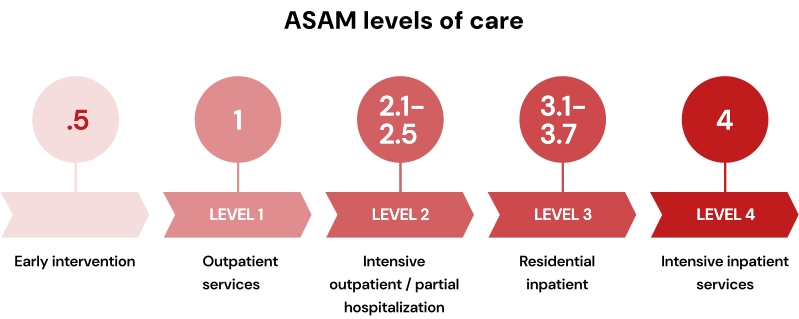
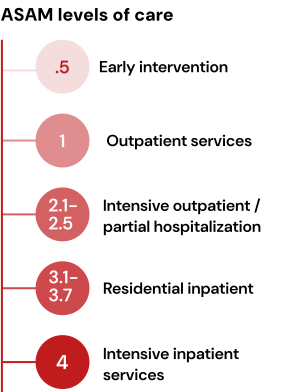
ASAM organizes levels of care on a scale from 0.5 to 4, with intensity increasing as the numbers rise. These placements are determined by evaluating all six ASAM dimensions, which take into account medical risks, emotional stability, motivation, relapse potential, and recovery environment.
Levels of addiction include:
Level 0.5. Early intervention services. Designed for people who are at risk of developing a substance use disorder but do not yet meet the full criteria. This may include prevention programs, educational sessions, or mandated interventions such as DUI classes. The goal is to intervene before substance use progresses to a diagnosable condition.
Level 1. Outpatient treatment. Less than 9 hours of care per week for adults. This level is appropriate for individuals with mild substance use disorders, or as a step-down from higher-intensity programs. Outpatient treatment often includes individual counseling, group therapy, education, and family sessions while allowing patients to maintain daily responsibilities.
Level 2.1. Intensive outpatient. At least 9 but no more than 19 hours of structured services per week. Treatment may occur in the evenings or on weekends to accommodate work or school. Medical, psychiatric, and laboratory services are available within 72 hours in person and 24 hours a day by phone.
Level 2.5. Partial hospitalization. At least 20 hours of structured programming per week but less than 24-hour care. Patients receive daily monitoring and a high level of support, but still return home at night or to a sober living environment. This option is often used when outpatient care is not sufficient, but full inpatient care is not required.
Level 3.1. Clinically managed low-intensity residential treatment. Residential services in a structured setting, often similar to a group home, with at least 5 hours of clinical services weekly. This level emphasizes relapse management, skill development, and building recovery routines in a supportive environment.
Level 3.3. Clinically managed population-specific high-intensity residential services. Programs designed for individuals with cognitive or functional impairments, such as traumatic brain injury or developmental disorders. Care proceeds at a slower pace, with additional reinforcement to support learning and skill-building.
Level 3.5. Clinically managed high-intensity residential services. A more structured form of residential treatment for people with severe psychological or social issues who require 24-hour support. These patients are often at risk of imminent harm without round-the-clock supervision.
Level 3.7. Medically monitored high-intensity inpatient services. Intensive residential services for patients with medical, psychiatric, or behavioral conditions that require close observation in a 24-hour setting. While not requiring daily physician interaction, patients receive oversight from addiction physicians, nurses, and clinical staff throughout their stay.
Level 4. Medically managed intensive inpatient services. The highest level of care, provided in a hospital or acute care setting. Patients receive 24-hour nursing support with daily physician visits. This level is designed for those with severe withdrawal risks or complex biomedical and psychiatric needs requiring direct medical management.
Rehab might feel like a big step, but remember why you're here—you’re looking for a way forward. We can help.
How the continuum of care works
Levels allow treatment to be delivered as part of a continuum of care, meaning a person can move up or down depending on their condition. For example, someone experiencing alcohol withdrawal with tremors, nausea, or seizures would likely require Level 4 medically managed intensive inpatient care to reduce life-threatening risks. Once stabilized, they might step down to Level 3 residential treatment, then into intensive outpatient or outpatient treatment as their recovery strengthens.
On the other hand, someone struggling to stop cannabis use without serious medical complications would likely begin at a lower level, such as intensive outpatient or standard outpatient treatment. This flexibility ensures that no one is over treated or under treated.
A guiding principle of the ASAM Criteria is to place individuals in the least restrictive setting that still meets their needs. When patients are placed in overly intensive programs without justification, research shows it can create frustration and resistance to care. Conversely, underestimating risks can expose people to medical danger or relapse. By applying the ASAM Criteria, professionals strike the right balance, supporting recovery while respecting each patient’s autonomy.
Understanding the ASAM Criteria helps patients and families know why a specific level of care is recommended and reassures them that placement decisions are based on decades of research-backed medical standards.
After the assessment
Understanding how providers determine recommendations is only part of the process. The next, and often more challenging step, is a person’s willingness to follow through with those recommendations. At times, patients and clinicians may have different views on which level of care is most appropriate. When this happens, seeking a second opinion from another qualified behavioral health professional can be valuable—just as you would do for any other medical concern. If multiple specialists provide the same guidance, it often reinforces the direction that will be safest and most effective.
Get the addiction treatment you need here
Recovery begins once you move beyond the assessment and commit to a care plan. The most important step is entering the recommended treatment program so that progress can start. If you or a loved one are unsure about where to begin, call (317) 707-9848 or complete our confidential contact form to learn more about the available levels of treatment and find the support that fits your needs today.
We are here to help you or a loved one find addiction treatment near you.
Admitting you have a substance abuse problem and asking for help is not always easy. If you or a loved one are struggling with drug addiction, alcohol addiction or another substance use disorder, help is available. Call SAMHSA’s National Helpline at (317) 707-9848 to learn about resources in your area or reach out to our team for personalized treatment.
Reviews
Will H.
Red Ribbon Recovery is an incredible place for anyone seeking help with addiction and mental health. The staff truly cares and go above and beyond to support their clients. The programs are professional, flexible, and effective. I’m so grateful for the tools I’ve gained here.
Danielle R.
I didn’t know what to expect when I got here, but Red Ribbon Recovery made me feel seen for the first time in a long time. The staff didn’t just treat me like a patient—they treated me like a person. They helped me through some really dark days, and now I feel like I’m finally moving forward.
Marcus T.
I’ve been to treatment before and it always felt cold or rushed. Red Ribbon was different. The staff actually listened. They helped me figure out what I needed instead of just handing me a schedule and hoping for the best. I still have work to do, but now I know I’m not doing it alone.
Sources
- American Society of Addiction Medicine. (2022). About us
- American Society of Addiction Medicine. (2023). About the ASAM criteria
- Substance Abuse and Mental Health Services Administration. (2025). Key substance use and mental health indicators in the United States: Results from the 2024 National Survey on Drug Use and Health (HHS Publication No. PEP25-07-007, NSDUH Series H-60). Center for Behavioral Health Statistics and Quality, Substance Abuse and Mental Health Services Administration. Available from: https://www.samhsa.gov/data/sites/default/files/reports/rpt56287/2024-nsduh-annual-national-report.pdf
- National Institute on Drug Abuse. (January 2018). Principles of Drug Addiction Treatment: A Research-Based Guide (3rd ed.). Bethesda, MD: National Institute on Drug Abuse. Available from: https://nida.nih.gov/sites/default/files/podat-3rdEd-508.pdf
About the content

Written by: Carli Simmonds. Carli Simmonds holds a Master of Arts in Community Health Psychology from Northeastern University. From a young age, she witnessed the challenges her community faced with substance abuse, addiction, and mental health challenges, inspiring her dedication to the field.

Medical reviewed by: Jodi Tarantino, LICSW. Jodi Tarantino is an experienced, licensed Independent Clinical Social Worker (LICSW) and Program Director with over 20 years of experience in Behavioral Healthcare. Also reviewed by the RRR Editorial team.
Red Ribbon Recovery is committed to delivering transparent, up-to-date, and medically accurate information. All content is carefully written and reviewed by experienced professionals to ensure clarity and reliability. During the editorial and medical review process, our team fact-checks information using reputable sources. Our goal is to create content that is informative, easy to understand and helpful to our visitors.